SEO Services vs Paid Ads: Which Strategy Should Your Business Invest in?
Ask ten marketers how they'd spend a tight marketing budget, and I promise you'll walk away with two completely different answers. Half of them will swear by SEO services, saying organic traffic just keeps giving long after you've stopped working on it. The other half will look you dead in the eye and say paid advertising is the only way to see real, measurable results starting on day one.
So who's actually right?
Honestly? Both. And also neither. Both strategies can absolutely bring in leads, sales, and revenue, but they go about it in very different ways. And if you don't understand those differences before you spend a dime, you're kind of just gambling with your marketing budget.
If you've been Googling SEO Services vs Paid Ads, digging around for a straight answer on SEO vs PPC, or wondering whether the best SEO services are actually worth what agencies charge, you're in the right place.
I'm not going to push you toward one side. Instead, I'll walk you through each strategy honestly, where it shines, where it kind of falls apart, and how a lot of smart businesses end up using both together to get the best of everything.
Understanding SEO Services
Search Engine Optimization, or SEO if you'd rather skip the mouthful, is basically the art (and yeah, a bit of science) of getting your website to show up higher in Google without paying for every single visitor that lands on it.
When you hire a professional SEO service, you're usually paying for a mix of things like:
- Keyword research
- Technical website optimization
- Content creation
- On-page optimization
- Link building
- Local SEO
- Website speed improvements
- User experience optimization
Here's the part I really want you to catch: unlike ads, which stop cold the second your budget runs dry, SEO keeps working. Once a page starts ranking, it can pull in traffic for months. Sometimes years. As long as you don't neglect it completely.
I like to compare SEO to buying a house instead of renting one. Yeah, the upfront cost stings a little more. But at the end of it, you actually own something that keeps producing value.
What Are Paid Ads?
Paid advertising, which most people just call PPC (short for Pay-Per-Click), is when you pay platforms to put your ads in front of people. That could be on Google, YouTube, Facebook, LinkedIn, TikTok, wherever your audience hangs out.
The big platforms most businesses use include:
- Google Ads
- Microsoft Ads
- Facebook Ads
- Instagram Ads
- LinkedIn Ads
- YouTube Ads
- TikTok Ads
Instead of earning your spot in search results the slow way, you basically bid your way in. Every time someone clicks your ad, you pay for that click. Simple enough.
The biggest perk?
Speed. Pure and simple.
You can literally launch a campaign at breakfast and be getting clicks by lunch. That kind of instant visibility is exactly why so many businesses lean on PPC when they need results fast.
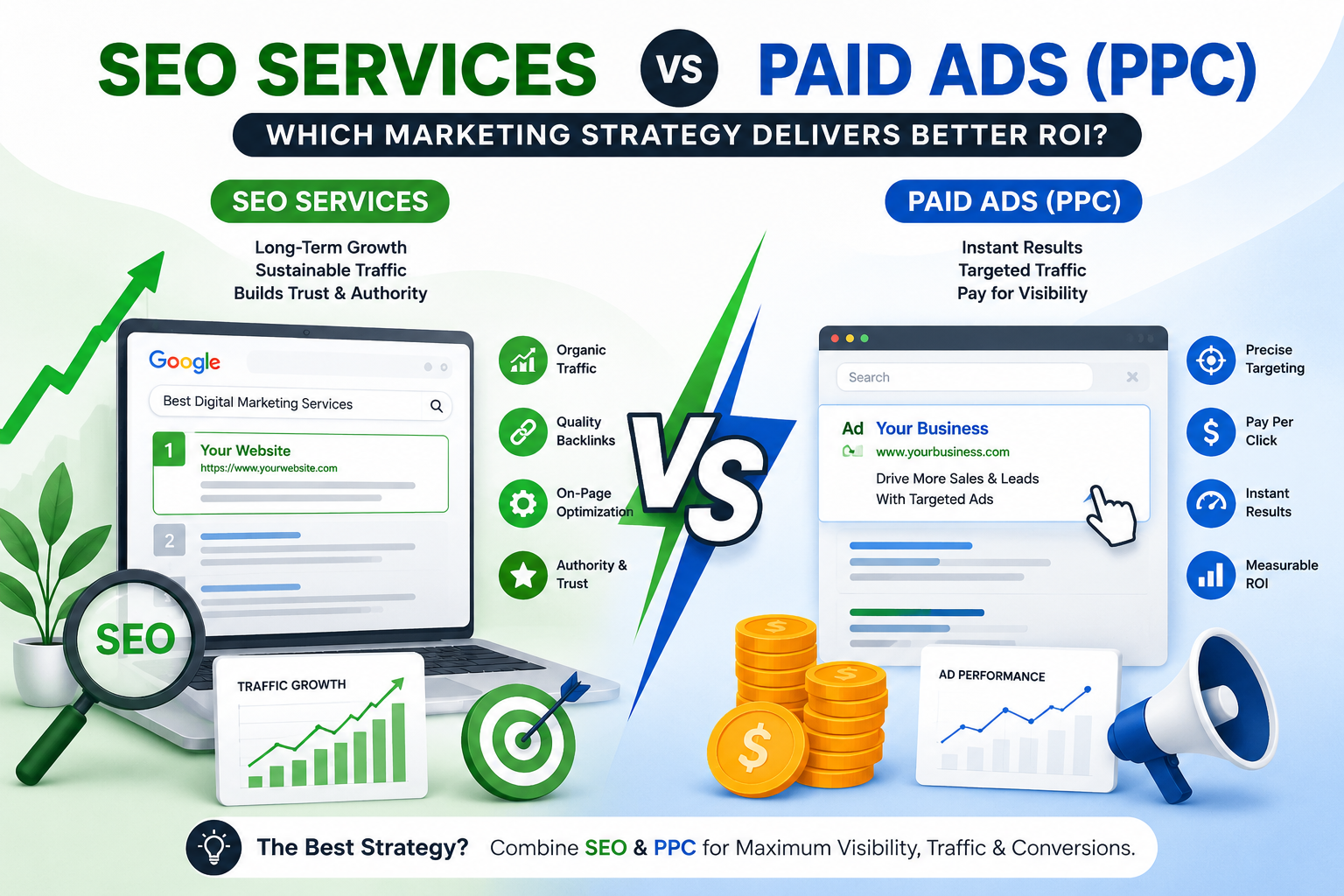
SEO vs PPC: The Biggest Differences
Both bring traffic. Both can grow your business. But how they get there? Night and day.
| SEO Services | Paid Ads (PPC) |
|---|---|
| Long-term investment | Immediate visibility |
| Organic search traffic | Paid traffic |
| Requires patience | Results appear quickly |
| Traffic continues after ranking | Traffic stops when spending stops |
| Builds website authority | Doesn't improve organic rankings |
| Lower long-term acquisition cost | Higher recurring advertising costs |
Neither one is "better" on paper. What's actually better depends entirely on your business, how much you can spend, how patient you are, and how quickly you need results.
Why Businesses Choose SEO Services
The main reason smart businesses invest in SEO? They're playing the long game. They want traffic that keeps coming even when they're not actively paying for it.
Picture this. You publish one really solid article, the kind that actually helps people. It slowly climbs the rankings, hits page one, and starts pulling in a few thousand visitors a month. And it just keeps doing that. Month after month. Without you spending anything extra per click.
That's why a lot of experienced marketers stopped calling SEO an "expense" and started calling it an "investment." Because that's really what it is.
Some of the biggest reasons businesses stick with SEO:
- Consistent organic traffic: Your rankings keep working for you, even when you're off the clock.
- Greater trust: Most of us naturally skip past the ads and click the organic results. That's just how people behave.
- Better return over time: Sure, SEO takes patience, but the cost per lead usually drops well below what PPC costs long-term.
- Improved website quality: Good SEO makes your whole site better: faster, cleaner, easier to use.
- Brand authority: When people keep seeing you show up for the topics that matter in your niche, you start to feel like the obvious expert.
Good SEO isn't just about rankings. It genuinely improves your entire online presence, whether Google's watching or not.
When Paid Ads Make More Sense
Now, SEO isn't always the right answer. There are plenty of times when paid ads are honestly the smarter move.
Let's say you're launching a new product next week. You can't exactly wait six months for Google to notice you exist. Running ads lets you get in front of people right away, no waiting around.
PPC really shines when you're dealing with:
- Seasonal promotions
- Limited-time discounts
- New product launches
- Testing new markets
- Generating leads quickly
- Retargeting previous website visitors
- Increasing brand awareness in competitive industries
And because every campaign gives you real, measurable data, you can constantly tweak things. Try different keywords. Switch up your audience. Test a new landing page. Adjust your budget. It's honestly one of the fastest ways to figure out what works and what doesn't.
That's the real magic of PPC: it lets you experiment without waiting forever to see results.
Which Strategy Delivers Better ROI?
This is the million-dollar question, isn't it?
And I hate to say it, but there's no clean answer.
If you need sales this week, ads will almost always win.
But if you're thinking bigger, like building steady traffic, cutting your cost per customer over time, and growing something that keeps paying off, SEO usually delivers the stronger ROI in the long run.
Across pretty much every industry, businesses with strong organic visibility pull in a huge chunk of their traffic from search. And here's the kicker: once you've earned those rankings, every additional visitor is essentially free. No click fee. No auction. Just people finding you.
That compounding effect is what makes SEO one of the smartest long-term bets in digital marketing.
Can SEO and Paid Ads Work Together?
Yes. One hundred percent yes. And honestly, this is where a lot of successful businesses quietly pull ahead of their competition.
There's this weird myth floating around that you have to pick a side. SEO or paid. Team A or Team B. It's just not true. The businesses winning right now? They're running both.
Here's how I like to think about it. SEO builds your future. PPC handles your right-now. Put them together and you've got a marketing engine that pays off today and keeps growing tomorrow.
Say you're launching a new service. You could run Google Ads to bring in leads immediately, while at the same time publishing well-optimized blog posts and service pages that'll slowly climb the rankings over the next few months.
Then, as your SEO kicks in and your organic traffic grows, you can start dialing back the ad spend for the keywords you're already ranking for. Basically, you're letting SEO do the free work while ads handle the gaps.
It's a much healthier balance, and it protects you from being completely dependent on ad budgets that never stop draining.
How Marketing Professionals Use Both Strategies
The best marketing teams I've worked with never bet everything on one channel. They use SEO and PPC for totally different jobs.
- Use SEO for educational blog articles.
- Use SEO for evergreen service pages.
- Run Google Ads for high-converting commercial keywords.
- Use paid ads during product launches.
- Retarget previous visitors with display advertising.
- Create SEO content based on PPC keyword performance.
- Improve landing pages using conversion data collected from paid campaigns.
The cool thing is that when you use them this way, they stop competing and start feeding each other. Data from your ads makes your SEO smarter. Your SEO takes pressure off your ad spend. Everybody wins.
Common Mistakes Businesses Make
Whether you're going all-in on SEO or throwing money at ads, there are a few really common mistakes I see over and over. And most of them are avoidable.
- Expecting SEO results in a few weeks. Look, SEO just doesn't move that fast. Rankings are earned, not bought.
- Stopping SEO once you hit page one. Your competitors aren't stopping. If you do, they'll pass you. Simple as that.
- Running ads to a bad landing page. The best ad in the world can't save a page that doesn't convert. Fix the page first.
- Ignoring analytics. If you're not looking at the data, you're basically flying blind.
- Hiring the cheapest SEO agency you can find. Cheap SEO usually means shortcuts, and shortcuts usually mean penalties down the road.
- Chasing clicks instead of conversions. Traffic is nice, but if none of it turns into customers, what's the point?
How to Choose the Best SEO Services
Not every SEO agency is worth what they charge. Some are excellent. Some are honestly kind of a scam. Before you hand over your money, take a hard look at their process, how transparent they are, and whether they actually know what they're doing.
Good SEO services usually offer things like:
- Detailed website audits.
- Comprehensive keyword research.
- Technical SEO improvements.
- High-quality content strategies.
- Ethical (white-hat) link-building practices.
- Monthly reporting with measurable KPIs.
- Clear communication and realistic expectations.
And please, run the other way if anyone promises you a "Guaranteed #1 Ranking on Google." Nobody can promise that. Not Google itself, not the best agency in the world. Anyone who says otherwise is either lying or hasn't done this long enough to know better.
Final Verdict: SEO Services vs Paid Ads
So, which one actually wins?
If you need results now, if you're testing something, or if you're running a short campaign, paid ads are probably your best bet.
If you're thinking about the long haul, wanting cheaper leads down the line, more brand credibility, and traffic that doesn't disappear the second you stop spending, professional SEO services are almost always the smarter play.
But honestly? For most businesses, the real answer isn't SEO or PPC. It's both. Used smartly. Working together.
Ads bring in the leads you need today. SEO makes sure those leads keep coming next month, next year, and beyond.
Anyone who's been in marketing long enough knows that the businesses with real staying power don't rely on just one source of traffic. They build a system.
If you've got the budget, my honest advice is to start with a balanced approach. Invest in real SEO. Run smart, well-managed ad campaigns alongside it. Over time, this combo tends to give you the strongest and most sustainable return on your marketing dollars.
🎥 Watch Related Video
Frequently Asked Questions
1. What is the difference between SEO services and paid ads?
SEO slowly improves your organic rankings over time, so you don't pay for every visitor. Paid ads get you in front of people right away, but you're paying for each click.
2. Which delivers better ROI?
Long-term, SEO almost always wins on ROI because that organic traffic keeps coming without you paying per click. Ads stop working the moment you stop spending.
3. Is SEO better than PPC?
Neither is flat-out better. SEO is your long-term growth machine. PPC is your quick-results tool. Best to have both, honestly.
4. How long does SEO take to show results?
Most businesses start seeing real movement somewhere between three and six months. Depends on how competitive your niche is and how strong your content and site are.
5. Can small businesses benefit from SEO?
Big time. Local SEO especially can help small businesses go toe-to-toe with much bigger competitors without needing a massive ad budget.
6. Should I stop running ads once SEO starts working?
Not always. A lot of businesses keep running ads for really competitive keywords or seasonal promos, even after their SEO is doing well. It's about balance, not one-or-the-other.
7. What are the best SEO services?
Look for agencies that actually care about technical SEO, good content, ethical link building, real reporting, and long-term growth. Anyone offering shortcuts is usually setting you up for problems later.
8. Does PPC improve SEO rankings?
Not directly, no. Running ads won't lift your organic rankings. But the traffic and data you get can help you make smarter SEO decisions later.
9. Which is more affordable over time?
SEO. By a mile. Once you're ranking, every visitor is basically free. With ads, you're paying forever.
10. Can SEO and PPC be used together?
Yes, and honestly, they should be. Combining them gives you fast results and steady long-term growth. That's usually the winning formula.